Monday, January 24, 2011

All housing supply conditions lead to higher prices! Amazing economic discovery by ANZ

This is so hilarious, I have to run it by you all -- according to this article, a bigger supply of housing will lead to higher house prices, AND a tight supply of houses also leads to higher prices!!!

Can you see what you're up against in the world of cash for comment reporting in the major influential dailies on behalf of vested interests like the banks and REIs?

From the article:

1. More construction is needed to stimulate more purchases of homes, which in turn helps push prices higher as overall confidence remains bullish. (!!!)

2. ANZ predicted that a shortage of available homes to rent would help spark prices by next year, perking up what’s been a lacklustre construction sector. (OK, maybe that's rentals in this context, but every other article out theresays there's a 'housing shortage' -- unlikely -- keeping prices high, and Australia somehow has lost all its builders and will to construct. Hundreds of thousands of employed workers are living in tent cities as I write this.)

So an oversupply of houses causes increased prices, and an undersupply causes increased prices!!! Marvellous, isn't it? Somebody seems to be always winning here. (And it's not the average ordinary housebuyer.)

And house prices apparently have nothing to do with easy supply of credit, novel lending forms encouraging speculators to borrow against other equity to 'invest', and low interest rates. Nothing at all.

Clearly what is desired is more mortgages for the banks, and the way to do that is 1) frighten everyone that houses will soon become even dearer using the mass media, and 2) make investors think it's actually a worthwhile investment – regardless of signalled interest rate movements in the near future and current very poor returns on housing as an 'investment' at today's prices.

PR masquerading as serious economic modelling. The ANZ in particular seems to have suddenly become the most aggressive bank in peddling lies, with similar offerings in Smart Company – I wonder if they are in the most trouble in the immediate future, reliant as they are on overseas wholesale funds to fuel the Australian lending frenzy, funds which are about to become a lot dearer for the bank.

Australians need to realise they are being exploited and abused by their banks and bankers.

Sunday, December 12, 2010

Treasury warning on home price 'bubble'

Can anyone work out WTF the ALP were thinking making Wayne Swan Treasurer?

"However, it is the considered position of the Treasurer and the Treasury that our housing market reflects the fundamentals of supply and demand and not a bubble - specifically that Australia is simply not building enough new houses."

Wrong on both counts as far as I can see. Assuming for a minute the confected lies were actually true, why then isn't Australia 'building enough houses'? (And where are all the people without houses living?) Surely that would represent some sort of national crisis the govt should be addressing urgently? So why aren't they?

I note Treasury use a report from vested interest Westpac as their bible also – who it appears may be almost on the skids based on their urgent borrowing of US Fed bailout money in a recent revelation.

I think Labor are deliberately keeping their heads in the sand so that if and when housing collapses they can pretend they had no idea. In the meantime, it's just unaffordable. They're forgetting the 'Labor values' of social justice and equality also in all this.

And we're actually paying people high salaries to be in a 'Household Demand Unit' in Treasury that is in equal measure useless and mendacious.

http://www.theaustralian.com.au/business/property/treasury-warning-on-home-price-bubble/story-e6frg9gx-1225956866267

A SENIOR Treasury official has sounded the alarm over Australia's property market.

He has warned that the prospect of a sudden and dramatic drop in prices is "the elephant in the room" and should not be ignored by the federal government.

While the government and Reserve Bank insist Australia does not have a housing bubble - as some economists and the International Monetary Fund suggest - it remains such a worrying concept that Treasury has privately sought reassurance from its analysts that prices are not artificially high and that Australia does not face the kind of house price collapse that has hit Britain and the US.

Friday, September 24, 2010

More ALP corruption and betrayal of their constituency

Ever wonder why negative gearing benefits are unassailable to the ALP? Or why their response to a housing bubble is to increase the First Home Owners Grant to a boost? Why none of their pronouncements on housing ever make sense? Why Tanya Plibersek as Federal Housing Minister was wont to say, in effect, 'the poor will always be amongst you, so you may as well make them your tenants!'.

Plibersek and the kitchen cabinet were moved to boost the FHOG solely on the request of the head of the REIA when real estate sales slowed down marginally from record highs, driving the Federal budget further into deficit in the process.

Constantly decreasing home ownership stats since 1986 (Hawke and Keating years), especially in lower income households, clearly indicate the ALP have become class traitors. Instead of using government's birds-eye view of the economy to tailor policy to a better outcome than the market can deliver, they instead lie about 'housing shortages' and raid the Treasury coffers to prop up speculative loss-making investors and real estate interests.

Real estate and the ALP

In considering the lack of action by the Victorian Labor government on real estate-related matters (except for allowing developers to now rip 20% off mug buyers), you need to look no further than the rice-paper thin closeness of the REIV and the ALP -- represented by no less than Robert LaRocca, an ALP apparatchik, and present chief lobbyist for the REIV. As well being a former Labor mayor, LaRocca was an adviser to a consumer affairs minister (Marsha Thomson) -- and had direct influence over that agency. The very agency responsible for overseeing the real estate industry -- Consumer Affairs Victoria.

An agency deeply compromised by its close relationship with the ALP, its director proudly spruiking her close relationship with various ALP MPs and a couple of ex-ministerial staffers now working within the agency. It's more a branch of King Street than Treasury Place.

http://www.crikey.com.au/2010/09/23/tips-and-rumours-318/


Home ownership fall will pressure welfare

People over 65 in Sydney now enjoy an 82 per cent home ownership rate, but
the proportion of lower-middle income households in Sydney without their own home rose from 26 per cent to 40 per cent in the 45-to-64 age group between 1986 and 2006.

''The substantial loss of home ownership by this age group was concentrated where it is likely to have the worst welfare outcomes as the group ages,'' an Australian Housing and Urban Research Institute study reported.

''They can expect a very long period of private rental under reduced circumstances.''

In 1986, about 60 per cent of middle-income households headed by people aged 25 to 44 owned their own home. By 2006 about 45 per cent were home owners.

There were now 217,000 fewer Sydney home-owning households in the 25-to-64 age group than if the tenure incidence levels of 1986 had been preserved.

Sydney's overall home ownership rate sat at 67.2 per cent in 2006, down on the 70.3 per cent level in 1986.

The report concluded the benefit of higher household incomes between 1998-2007 went into pushing up house prices and debt rather than improving home ownership equity or increasing the stock of housing.

''The very high housing prices that are currently extant are a major concern. It is our contention that this situation has been caused by government action - a deregulation of finance in the 1980s with no corresponding deregulation of planning.

''High house prices act as a drag upon growth and competitiveness, have exaggerated inequities in wealth and intergenerational inequity, and they will eventually increase the welfare burden.''

http://www.smh.com.au/business/property/home-ownership-fall-to-pressure-welfare-20100919-15hyt.html

Thursday, January 01, 2009

A couple of announcements

Australian bailout of dodgy banks
(and I thought we were 'decoupled' from the international maelstrom in the US, UK and now Europe)

The Australian Federal government is doing its very own version of the US bank failure bailout with taxpayer's money, so it can keep the Ponzi scheme going a bit longer and stop market prices for housing correcting somewhere back to where they should be.

Dan at bubblepedia.net.au has sent the following note:

There is a bailout happening right now under our noses for the gamblers. I object in the strongest possible terms to wasting my tax dollars to pay the gambling debts of our own sub prime lenders in an attempt to keep the bubble going for just one more electoral term.I'm trying to get people writing and shouting here: http://bubblepedia.net.au/tiki-view_blog.php?blogId=9

There is also a lot of treatment of the bailout at the Australian forum of the Global House Price Crash site.

Affordable housing competition

There's a competition to produce a 3 minute film of anything to do with 'busting the myths of the housing crisis' from the incredibly busy and energetic team at Earthsharing Australia. I'm very late announcing this competition here, apologies, and I haven't had time to put in a contribution either, unfortunately. However, any quality will do, down to a mobile phone camera...

We are working on a film competition right now called "I Want To Live Here"- it's a call out to those feeling disenfranchised or 'fenced-out' of the housing market to bust the myths of the housing crisis. We want people to share their stories, explore the causes and effects of the housing crisis and speculation into a 3-minute film of any genre or style.

The winner will receive a $3000 cash prize.

The Top 3 film will be shown at an Official screening and the winner announced in early December. Entries are Open now until October 2nd.

Regards, Mia
--I Want To Live Here Film Competition — Bust the myths of our Housing Crisis--
Earthsharing Australia
HQ: 1/27 Hardware Lane, Melbourne 3000
Ph: (03) 9670 2754
http://www.iwanttolivehere.org.au/

Wednesday, December 31, 2008

Statement concerning the failure of governments to govern

With regard to watching the housing 'boom' unfold without oversight, disenfranchising the next generation, we can only accuse governments of callousness and indifference, if not rampant profiteering wherever possible.

Housing and the real estate industry has become a giant Ponzi scheme, and governments are happy to simply sit back and observe — when they're not busy selling off Crown land to the highest bidder themselves and taking increasing stamp duties to plump up their coffers. With rising interest rates and property already hugely overvalued in Australia, we are about to witness a train wreck in slow motion as the Ponzi scheme comes off the rails.

Well paid but highly unimpressive ministers, advisers and public servants fail to see the economic chain of cause and effect caused by allowing speculation in housing and land to run rampant. Lowering interest rates to stimulate the economy (often after a stock market crash, also caused by speculation) only leads people to irrationally pour capital into housing instead, elevating prices well above sensible returns on investment, and denying affordability to many, causing a failure of the social settlement. High mortgage repayments lead price setters such as shopkeepers to elevate their prices to cover their living costs. (However, high mortgage repayments also cause consumers to draw back from making purchases.) The higher cost of everything eventually causes industrial unrest and disruption and wage inflation, and eventually sparks a spiral of general inflation. The response is to push interest rates up again, causing more damage to home budgets and businesses. Nobody's quality of living has gone up except for real estate industry workers and the empty nesters who cashed out their homes. Meanwhile, governments keep taking things out of the CPI calculation to try to keep wages under control by hiding the real size of inflation. For some reason, you don't seem to get this story anywhere, not from the Reserve Bank, not from Treasury.

CHIRS - Community Housing Online:

With regard to the politicians, with their 2 year longview on everything:

The main barrier to progress appears to be that housing continues to lie off-centre from the main economic, social and political concerns of governments at all levels. In part, this involves an inertial lag effect. For most of the post-War period, the vast majority of Australians have been well housed by historical and international standards. Housing, labour and financial markets worked together to ensure that housing standards were adequate or better for perhaps 85 per cent of the population. A similar proportion of the population became home owners at some time during their lives. The fact that this dominant housing career and expectation has broken down over the past 20 years appears to have eluded many policy makers, who still look to the housing market operating within conventional parameters to meet housing needs for all but a tiny residualised group in the population.

It is this dominant view—along with the tendency to uncritically celebrate house price inflation as a sign of a healthy economy and domestic world—that needs to be taken head on by people concerned with both Australia's long term economic sustainability and the immediate social problems of declining housing affordability for an increasing number of Australians.

Show me the money: financing more affordable housing - Mike Berry

While it lasted, the boom added substantially to the wealth of existing home owners, but it has made home ownership more expensive for aspiring new buyers. In its aftermath, three questions arise. First, who financed the capital gains that home owners have enjoyed? Second, has home ownership become unaffordable for the younger generation? And third, what, if anything, should the government be doing to help young families get onto the home ownership ladder?

Rapid house price inflation also has wider economic costs, for it can distort the way we use capital. The Productivity Commission notes how, ‘Rising prices can create expectations of further price increases, unrelated to any change in market fundamentals. Young workers rush to take out huge mortgages before house prices spiral out of reach, and older buyers are seduced into investing in rental property while disregarding falling rental returns. Panic buying creates a housing ‘bubble’ which sucks money out of productive investments and eventually threatens the whole economy.’

Just as damaging in the long-term are the sociological effects of high house price inflation. The longer a housing boom goes on, the more it is likely to foster what Max Weber called a spirit of ‘booty capitalism’ emphasising pursuit of short-term windfall profits at the expense of hard work, thrift, enterprise and long-term planning. When passive ownership of a house delivers riches far beyond what most people could accumulate from many years of working and saving, traditional virtues emphasising hard work, saving, enterprise and deferred gratification are likely to get eroded, yet these are values on which capitalist liberal democracy ultimately depends. Savings, certainly, have been in free-fall. The household savings ratio, which was 10% in 1990, is now negative, and debt servicing is costing an average of 9% of personal incomes.

After the House Price Boom - Is this the end of the Australian dream? - Peter Saunders

Causes of the housing boom

There have been a number of secular trends in recent decades around household formation and income which have combined to drive up housing prices excessively, and, I hope, unsustainably. These include:

  • greater female participation in the workplace, leading to many more double income families, coupled with free market bidding for housing based on what lenders will lend the individual, not what individuals need
  • smaller family sizes, possibly partly due to greater workforce participation, individual preference, and so on - partly in order to guarantee a better quality of life for individual children

This has been combined with the continuation of rampant free market commodification of residential property for citizens, where government deliberately keeps out of residential real estate pricing, leaving it to a bidding process in the open market, but reaping enormous stamp duty dividends, land tax and Council rates as a result.

These free market conditions include:

  • the sudden liberalisation of credit at a higher risk profile for the banks and other lenders; rise of the NBLs (non-bank lenders) and lo-docs/subprime loans; greater use of interest only loans; and the equalisation of interest rates on loans for investment properties and PPORs (principal places of residence)
  • present low interest rates, which are now steadily increasing to fight 'inflation', a good percentage of which has been caused by overheated housing prices
  • the advent of 'spruikers' promoting get-rich-quick schemes based on speculative and exploitative behaviours in the property market, and maximising tax breaks, especially 'negative gearing' in the Australian case — see http://www.jenman.com.au/ for examples
  • the capitalisation of high stamp duty, and other government levies and charges, into the cost of housing — the 'ratchet' effect
  • increasing desperation of purchasers, leading to more inflation and a hysteria effect — à la the Dutch 'tulip boom'
  • irrational exuberance of speculative investors (yes, just like in the Great Depression, the dotcom 'tech wreck' and numerous other housing bubbles in the last century which have all ended badly); belief that future infinite capital gains will bail them out for high prices and ongoing losses now. See Steve Keen on 'Minsky's Financial Instability Hypothesis' as a counter to the neo-classical 'equilibrium theory' of markets - http://www.debtdeflation.com/blogs/2008/03/10/time-to-read-some-minsky/
  • plenty of developers, real estate agents and baby boomers highly prepared to cash in on this desperation and greed
  • the permeability of the real estate market to other markets as an investment vehicle, and relatively low costs of purchase compared with other countries
  • very few protections for owner-occupiers in terms of cost controls, except the limit of what the market will bear
  • in Australia, very generous negative gearing rates for investors compared with other countries, where housing investment losses are offset against all income, not just income from the property, meaning that the Tax Office is happy to be an equal partner in any loss for top bracket income earners.

Unfortunately, every single spare cent in households then becomes 'capitalised' into purchasing real estate, in a bidding war between couples and investors, both long-term and speculative.

Policy suggestions for more affordable housing

My policy suggestions designed to make housing more affordable in Australia and limit the effects of a rapacious, destructive boom include (and are by no means limited to):


  • requirement of at least 33% of new development to be 'affordable' properties, rather than the current paltry 3% set by state governments — these higher rates are the norm in the UK and France
  • PPP developments and partnerships sponsored by government on state, Crown and ex-Defence land – and involving more partnerships with SME construction firms than with big players, thus cutting out fat developer profits, and land speculation profiteering
  • release of Defence, State and Crown lands for responsible, affordable, environmentally sustainable development, e.g. disused hospital sites, ADF bases, RTA land, empty land and so on, with price covenants on developments
  • control and lowering of land costs where owned by the state or Federal governments, which have an arbitrary value anyhow, rather than selling off land willy-nilly to the highest bidder to plump up state and Federal coffers
  • setting long-term price covenants on developed affordable properties under the above regimes, indexed only to CPI or median wage increases, and an at-cost-only allowance for any further renovation value added by owner-occupiers (as assessed by a valuer)
  • boosting and improving the stock of both 'public' housing and 'social housing', i.e. cost-controlled housing as described above. Labor Ministers such as Mark Latham and Cherie Burton benefited from this sort of housing growing up, but it has been abandoned more recently due to eco-rat market principles infecting government.
  • creation of leasehold titles to be held in perpetuity by government, with the intention of controlling the selling prices of properties developed on them, and to ensure responsible control is retained over the land — this may be an inferior approach to the above approaches
  • bypassing/removal of real estate agents and associated advertising charges and hefty commissions in selling these properties, given that they will shift without the need for an agent, and that agents' fees contribute to the 'ratchet effect' in housing
  • stamp duty and other transaction cost waivers on these properties, similar to NSW 'HomePlus' scheme for first home buyers
  • levy a land tax on unused property in urban areas – this tax could be allocated at local government level, to be returned to cash-strapped Councils. The tax would serve as an inducement to sell up rather than hoard disused land and property, both on small and large scales — see the oligopoly of developers and use of land banking to control supply as yet another factor. Gough Whitlam showed courage and broke up this cartel in the 70s, today's Labor are too compromised to address the issue.
  • streamlining approval processes with local Councils for new construction (this is one of the more minimal suggestions currently put forward by state and Federal governments, so that they can blame someone else for the problem)
  • lobby Federal Government to stop negative gearing breaks and capital gains tax concessions for investors and implement workable incentives towards home ownership which do not go on to further inflate housing prices; or else the implementation of policy and legislation to offset existing destructive arrangements by the Federal Government. For instance, negative gearing breaks could be quarantined to apply only to rental incomes, not total personal income, as in the UK and the US.
  • resumption of land if necessary, e.g. to unite two blocks with a small title between them, or to reclaim an unused or underused site from an unwilling vendor in the public interest. The non-negotiable offer of discounted prices to large vendors such as at the CUB brewery site at Ultimo, Sydney. They have profited enough from the drinking habits of the working class over nearly two centuries – it's time to put something back. It's interesting that the land at Kurnell was going to be 'resumed if necessary' for the now shelved desalination plant – very tough-talking stuff when it comes to projects like that, but nothing in housing? The RTA is always resuming land to put through new freeways, using its extensive powers.
  • the passing of legislation and creation of taxes to control land prices and prevent capitalist boom/bust waves and discourage speculative activity in property, to 'nationalise' the sale and pricing of property to some extent, to curb and keep real estate agents in check in any number of ways with stiff penalties (including making inflationary and misrepresentative claims of unlimited capital growth to gullible purchasers, encouraging the creation of endless 'investment properties', REI media announcements to this effect) and banning unethical practices to allow for decent affordable owner-occupied housing. Allowing the sale of rental properties only for the use of itinerant workers, visitors, and overseas students, etc. (More decent and affordable accommodation needs to be created for overseas and local students also to reduce current apartment overcrowding problems – currently there are 2 and 3 bedroom apartments all over the city containing up to 10 overseas students.) Better inclusionary zoning and affordability measures around the capital cities to allow ordinary workers to live in the vicinity of their work, thus solving some of the transportation problems of the city and improving social capital.
  • stop bun-fighting and buck-passing across the tiers of government, and take ownership of the problem at all levels. It's ludicrous to expect individual councils to manage housing affordability individually with limited powers and resources and with no holistic plan across the city and state, to say nothing of the pecuniary conflicts of interest which appear with monotonous regularity.
Note that I do not include suggestions such as: shared equity arrangements, developer levies, inappropriate grants to buyers which only serve to further inflate prices in an uncapped and uncontrolled market, 40/50 year mortgages, low or no docs mortgages, or other such free market attempts to maintain inflated prices for the main benefit of banks and real estate agents.

A price correction is needed, and governments must provide affordable places whether or not real estate prices in the open market crash in the next few months and coming years or not.

It appals me that governments instead are willing to attempt to profiteer from these inflated prices by selling prime land and taking excessive stamp duties at the top of an unsustainable capitalist price wave. And, as we know, the whole house of cards is now tumbling down starting with the collapse of mortgage derivatives in the US that fed credit into the rest of the OECD, with a credit freeze and the disappearance of billions in non-existent 'value' off assets and derivatives.

Monday, December 31, 2007

Is household debt getting worse?


Even though home prices have stopped rising in most parts of the country, household debt continues to grow.

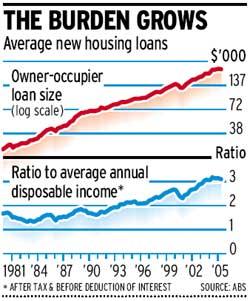
The ratio of household debt to income has reached a record 150 per cent - one of the highest in the world - and the ratio of house prices to disposable income is also very high by historical and international standards.

The share of households with debt secured on their home is rising, having jumped from less than 30 per cent in the mid-1990s to 36 per cent.

"The household sector remains vulnerable to a deterioration in the economic climate, and there remains a possibility that the adjustment could turn out to be much larger than currently anticipated," the report said.

Is household debt getting worse?

Note how spiralling housing costs have fed into the national debt, creating an unproductive international debt to service.

Note also that many small retail businesses are going to the wall, as disposable income is at an all time low.

What does the NSW Labor government and Australian federal Government do about it? Nothing, of course... It's far easier and politically correct to be laissez-faire and eco-rat (while still dashing off important-sounding polished speeches about nothing) and let new and prospective homebuyers (and the macro-economy) suffer.

Saturday, November 24, 2007

Mortgage stress may be behind Bible belt crime

Quelle surprise:

SYDNEY'S Bible belt is known for its McMansions, aspirational voters and enthusiastic church-goers. But the conservative, affluent Hills District is also in the grip of a crime wave - and mortgage stress may be behind it.

Over the past four years, Baulkham Hills Shire has experienced rising rates of violence and robbery. Domestic violence has risen by almost 20 per cent, assault is up by almost 10 per cent and harassment by 23 per cent.

There have been five murders in the past two years; there were none in the five years before that. They include the stabbing murder of Richard Carruthers, the 36-year-old redesigner of the Olympic cauldron, in his Castle Hill home. Three of the murders remain unsolved.

Many families in the area are also struggling financially, which can influence domestic violence statistics. "What you have in the Hills District is more people paying more off home loans than the rest of Sydney," Dr Lee said.

"You've got 50 per cent of home owners paying more than $2000 a month off a home. That's at least 10 per cent more than the average. I'm not saying it's causal, but I think it's an interesting figure."

The Local Area Commander, Superintendent Sue Waites, also suggests a link between financial stress and domestic violence. Domestic violence problems could also be fuelling the 23.2 per cent rise in harassment, threatening behaviour and private nuisance charges. "[Incidents] include sending inappropriate text messages to persons via mobile phones," she said.
Mortgage stress may be behind Bible belt crime - National - smh.com.au

Saturday, November 03, 2007

Tale of two Sydneys as property divide widens

SYDNEY'S two-speed property market could continue this year as mortgagee-in-possession sales drag down the lower end of the market.

An Australian Property Monitors rating of the growth of property values of about 700 suburbs in 2006 shows the city's affluent enclaves surged ahead, while areas in the west and south-west languished.


Tale of two Sydneys as property divide widens - National - smh.com.au

Tuesday, October 09, 2007

Sydney not alone in seeking housing crisis solution - National - smh.com.au

hmm, Jess Irvine hasn't done a market-pumping piece funded by the REI for a change -- remarkable... As per the article, if politicians want policy suggestions, just come to this site. They are looking at releasing urban Defence land as well as the State and Crown lands, to answer the vexed 'where will the land come from?' question...

Sydney not alone in seeking housing crisis solution

Wednesday, October 03, 2007

Rent crisis taking psychological toll

THE rental crisis is having negative psychological effects on tenants, with a growing number reporting rent-associated depression and anxiety.

About one in three Australians rent and the survey by realestate.com.au showed 89 per cent of renters reported experiencing negative psychological effects directly related to the rental climate.

Fifty-nine per cent of renters expressed "anxiety" over their renting predicament. Forty-one per cent felt "helpless" in their rental situation and one in five said they felt rage and fury over their situation.

Only 11 per cent of renters are happy with their current accommodation and only 4 per cent feel well cared for by their landlords, the survey found.

But even with a shortage of good accommodation and rents rising by 9 per cent during 2007, the majority of respondents said they would rather stay in less than ideal rental properties then go back into the market.

Fifty-six per cent of prospective tenants were deterred from applying for properties based on the number of people at inspections. More than a third said they felt they would never be able to own a home.

Rent crisis taking psychological toll | The Daily Telegraph

Thursday, September 06, 2007

Credit squeeze hits Aussie banks

There you have it -- the banks opened up the credit floodgates 5 years ago, precipitating the boom, and now it's come full circle -- massive levels of foreclosure, housing inflation, indebtedness, borrowing and consumer risk, so they turn tail and restrict credit again. Of course, 'the gummint is managing the economy'. At least APRA could have done something, but they did very little -- it took an international credit squeeze to stop the local largesse.

This could bring down house prices, because

1) people can borrow less, thus reducing bid prices
2) they will probably also have to pay more interest, also reducing how much they are prepared to pay for housing.

Credit squeeze hits Aussie banks

Tuesday, August 28, 2007

Victoria pulls ahead

So cheaper Victoria is pulling ahead of property price-gouging NSW -- and yet heightened demand in Victoria isn't escalating house prices through the roof! Very interesting.

NSW is losing the economic race to Victoria, with residents fleeing high property prices and dragging down the state's economic growth.

About 25,000 NSW residents leave for other states and territories every year. And the exodus is constricting the state's economy, with NSW slipping behind its southern neighbour, new analysis by the ANZ's head of Australian economics, Tony Pearson, shows.

Mr Pearson said the Victorian economy had grown twice as fast as NSW's in the last two years, in part due to demographic factors.

"What stands out is the much poorer economic performance of NSW against its peers, particularly relative to Victoria."

Victoria pulls ahead

Monday, August 13, 2007

Housing affordability hits new record low

Those hard-working pollies who 'manage the economy' (or so they keep telling us) are at it again, fixing up the housing affordability problem. Anyone would think they just swanned around for a living delivering speeches, attending openings and taking credit for other people's work, and playing political games with developers, big business, and anyone else with loads of cash. The key words are 'tangible policy action':

"The Australian economy is performing well yet an increasing number of Australians are now being left behind as the degree of housing stress being felt by both mortgage holders and renters continues to intensify," Dr Silberberg said.

"The longer we go without tangible policy action, the worse the situation will become, and that's without higher mortgage rates."


Housing affordability hits new record low

Thursday, August 09, 2007

Ten's company: what the rental squeeze means for owners

More on the housing/renting/apartment overcrowding debacle -- this is what happens when you leave housing in a capitalist free market with laissez-faire politicians 'running' the country -- out and out exploitation of overseas students, rampant unaffordability, and horrible life experience. When was it decided Australia was the land of the 'fair go', and by whom, particularly since it has become populated with property developers and landlording piranhas, the 'fair go' mums and dads of yesteryear.

Ten's company: what the rental squeeze means for owners

Wednesday, August 01, 2007

Home ownership now an 'unattainable dream'

HOME ownership has become an unattainable dream for many low- to middle-income earners in Australia, a new report has found.

The Beyond Reach report, undertaken by the Residential Development Council (RDC), examines the cost of owning or renting a house or unit for six household “types”, comprising different family and wage structures, in 16 metropolitan locations across the country.

It shows owning a median-price home in almost any location in Australia requires a combined household income of about $100,000, while the average annual wage for workers is $55,000 a year.

According to the report, not one of the 16 locations studied offered a median-priced home that was affordable on that level of income.

In calculating affordability, the report used two different measures - that no more than 30 per cent of household incomes should go on housing costs, and a property should cost no more than three to four times the median household income.

RDC executive director Ross Elliott said the research provided a more human angle on the affordability crisis.

“If key workers necessary for society and the economy to function are being denied entry to the housing market, or if the option of a single income family is now completely shattered by the price of housing, we are faced with obvious long-term social and economic consequences,” he said.


Home ownership now an 'unattainable dream' | The Daily Telegraph

Tuesday, July 31, 2007

Why is housing so expensive?

A nice summary article on the speculative real estate market:

Why is housing so expensive?

Sunday, July 15, 2007

THE POLITICS OF AFFORDABILITY

A great public service article on Neil Jenman's website (www.jenman.com.au), written by Terry Ryder. A fantastic synopsis, well worth reading in its entirety:

It's almost tragic watching politicians and media puzzling over the two-speed property market and the related issues of low housing affordability and record home repossessions.

The reasons are quite simple.

The common factor pervading these issues is this: Australia's economy is booming but the spoils aren't being evenly shared.

Most of the benefits of the resources-inspired prosperity are being gobbled up by the upper echelons. While the top end is rolling in cash, the average person is no better off than five years ago.

The business elite have never had it so good. Record company profits, generous executive salary packages and a buoyant sharemarket mean those at the top have more dollars than ways to spend them. This is driving the rise and rise of the top end of the residential property market.

But down in the real world, the mainstream where 90% of Australians live, the market is going nowhere fast.

More and more households cannot afford to buy a home, those who already own one are struggling with their mortgages after eight consecutive interest rate rises and banks are repossessing homes at record levels.

The wages report shows that over the period of the economic boom wages have grown at roughly 2% to 3% a year. In other words, not much above the inflation rate. The report states that a significant proportion of households have seen no "real" (after inflation) increase in their incomes over the past five years.

But in the same time frame property prices have doubled in many areas and there have been multiple rises in interest rates.

The problem is this: the typical price has risen a lot, thanks for the recent market boom, and the typical monthly payment has risen greatly also, thanks to all those interest rate rises from the Prime Minister who promised they wouldn't rise if we re-elected him – BUT household incomes haven't kept pace, thanks also to that same Prime Minister who has devoted his life to keeping wages down.

In the property booms of the 1970s and 1980s, prices rose a lot and interest rates were high, but incomes were rising at 8%-9% a year, so affordability didn't suffer too much.

Today, the growing gap between the income needed to get a loan and the actual income earned by the average family is the reason why affordability is at all-time lows – and why we have this strange two-speed property market.

You'll notice that there's no mention in the affordability equation of stamp duty or land supply.

This is a surprise because the development lobby has been desperate to convince us that affordability could be solved overnight if state governments lowered stamp duty and raised the supply of land for new residential development.

It's nonsense but they keep saying it because they have a vested interest in lower stamp duty and higher land supply.

So why is this deception not widely known?

Part of the answer is that media doesn't do its job. There was a time when journalists were proactive in investigating major issues like affordability. Today many journalists simply regurgitate the spin-doctored views of politicians and business lobby groups.


THE POLITICS OF AFFORDABILITY